The work
How hardwood floor refinishing actually goes on a JL job.
Montgomery County's pre-1990 housing stock contains a substantial inventory of original site-finished hardwood floors that are now worn through their factory finish but still structurally sound. Red oak strip flooring, the most common residential hardwood from the 1950s through the 1980s, was site-finished with oil-modified polyurethane that, with care, has lasted decades — but in entryways, kitchen runs, and high-traffic hallways, that finish has worn through to bare wood and the underlying boards are now absorbing moisture and dirt unevenly. The good news for most homeowners is that these floors are recoverable. The original 3/4-inch tongue-and-groove flooring has enough thickness for at least one full refinish, often two or three, before nail penetration becomes a concern.
Diagnosis comes before the sander runs. Cupped boards — high in the middle, low at the edges — indicate moisture imbalance from below the floor, common in homes with crawlspaces, basements without vapor barriers, or post-flood drying that was rushed. A cupped floor must equalize to indoor moisture conditions (typically 6–10% moisture content for the MontCo climate) before sanding, or the new finish will crown as the wood continues to lose moisture. Gapped boards in winter are the opposite problem — winter heating drops indoor humidity and the boards shrink; gaps that re-close in summer are not a refinish concern, but gaps that remain year-round indicate the boards have been over-dried and may need replacement of severe sections. Jose evaluates each of these conditions during the estimate.
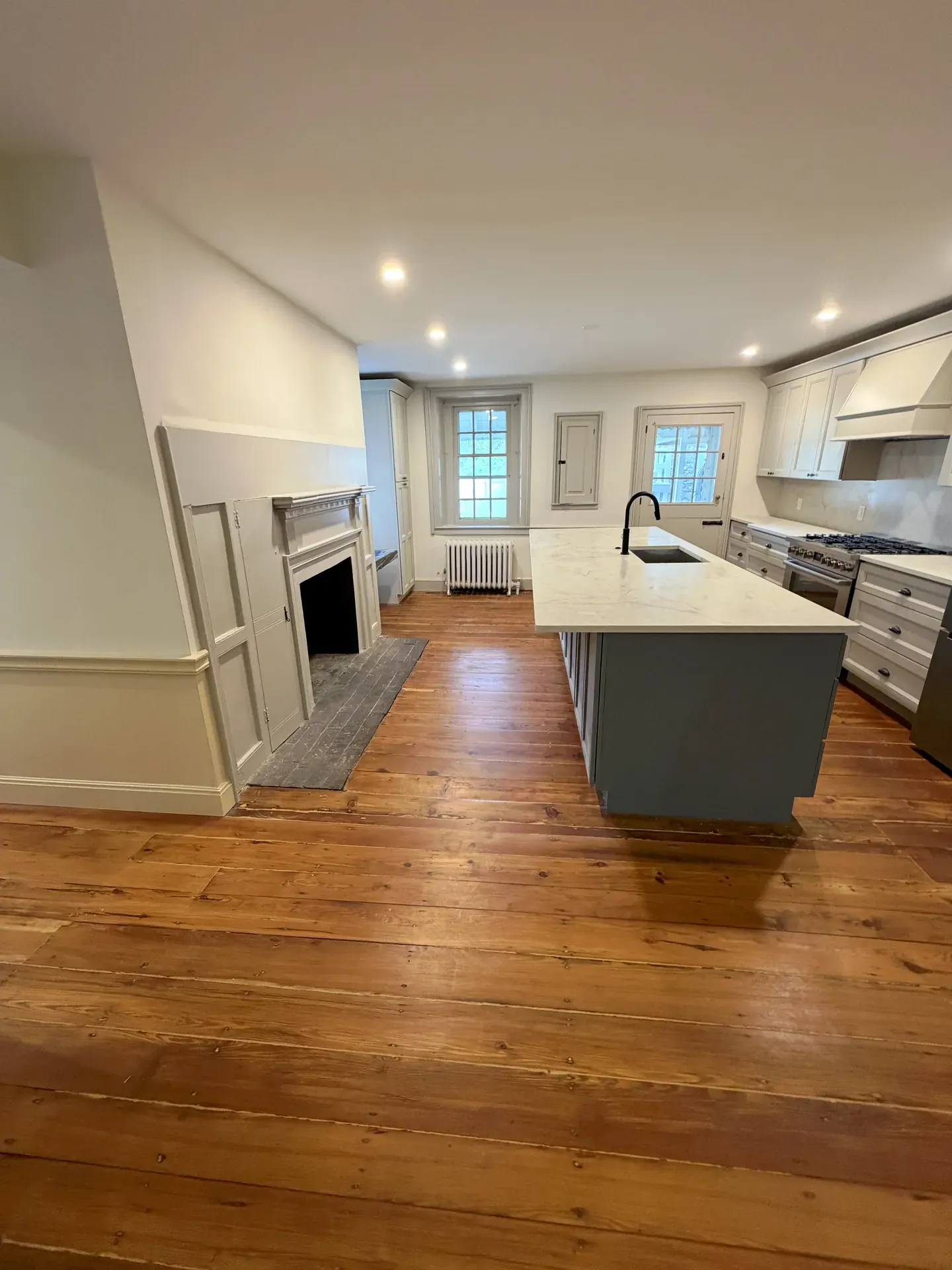
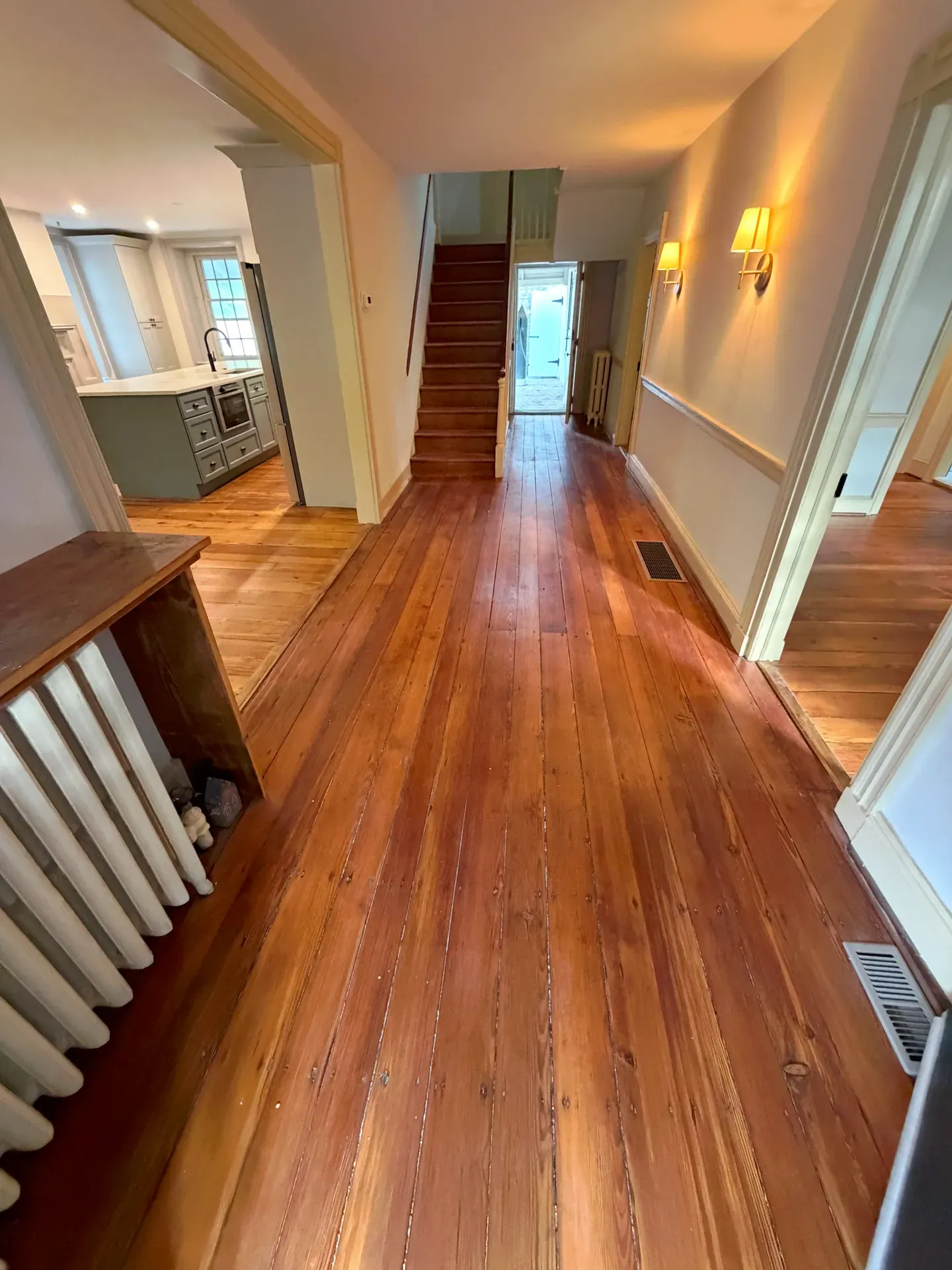
The sanding sequence on a residential refinish is graduated. The drum sander starts at a grit determined by the existing finish condition — 36–40 grit for heavy polyurethane buildup or paint contamination, 50–60 grit for normal wear without major damage. Subsequent passes step up to 80 grit, then 100, with the edger working the perimeter the drum cannot reach and a buffer running 100–120 grit screens to blend the drum and edger passes. Hand-sanding addresses corners, returns, and any spot the powered equipment cannot access. Wide-plank pine floors found in pre-1940 North Wales Borough homes get a gentler sanding sequence because the softer wood does not need aggressive cuts and can be damaged by an inexperienced drum operator. Dust containment uses a Bona Atomic DCS or equivalent vacuum sealing system — the floor refinishing process is dramatically dustier than people expect, and proper containment is the difference between a manageable cleanup and a week of fine dust settling on every horizontal surface in the house.
Finish selection drives both the aesthetic and the maintenance schedule. Oil-modified polyurethane (Bona Mega, DuraSeal Quick Coat) ambers with age, has a traditional warm look, and develops a recognizable patina over years — many homeowners restoring older homes choose this finish to match the historical aesthetic. Cure time is 24 hours between coats and a week before normal furniture-and-foot-traffic use. Water-based polyurethane (Bona Traffic HD, Loba 2K Easy Finish) stays clear with no amber shift, has faster cure times, and offers significantly harder wear resistance — the right choice for high-traffic kitchens, entryways, and rental properties. Hardwax-oil finishes (Rubio Monocoat, Loba Markant) penetrate the wood rather than building a film on top, making them spot-repairable years later without sanding the entire floor — appropriate for homeowners who want a maintenance-flexible finish on a high-value floor. Jose specifies the finish based on traffic patterns, light exposure, and the homeowner's maintenance preference.
JL Drywall and Painting refinishes hardwood floors across North Wales, East Norriton, King of Prussia, Blue Bell, and Skippack — from a single hallway run-out to a whole-house refinish in a Blue Bell colonial. The protocol is multi-day for a reason: sand, edge, screen, finish, dry, screen, finish, dry, screen, finish. Services that promise a one-day refinish use chemical etch-and-recoat systems that work only on floors with intact factory finish and no significant wear — they cannot restore a worn-through entryway and will fail in months if applied over a substrate the system was not designed for. Jose declines that approach.