The work
How carpentry actually goes on a JL job.
Exterior wood is the trade where weatherproofing, structural integrity, and finish quality all intersect. Work done well lasts decades; work done with shortcuts on substrate prep or end-grain sealing starts visibly failing within the first winter. The services under this category — cedar tongue-and-groove (T&G) siding, custom exterior stair construction with steel railings, fence and gate work, decorative wood feature walls — share a common skill set in detail carpentry. The work has to be straight, plumb, weather-sealed at every joint, and finished in a way that resists the freeze-thaw cycling, UV exposure, and moisture intrusion that defines the Mid-Atlantic exterior environment.
Cedar is the primary species for the work shown in JL's portfolio. Western Red Cedar (the standard in the Philadelphia metro) has natural rot and insect resistance from its high tannin content, dimensional stability when properly acclimated, and a workable finish profile that takes both clear oils and pigmented stains. JL installs cedar in three primary configurations: vertical T&G siding for full-wall exteriors and architectural feature walls, horizontal lap or T&G siding for traditional rowhouse fronts and additions, and tight-margin cedar paneling that wraps stair stringers, deck framing, and rail caps. End-grain sealing is non-negotiable on every cut — exposed cedar end-grain wicks moisture five to ten times faster than face grain, and most cedar work that "just rotted out" within three years failed at unsealed end-grain joints.
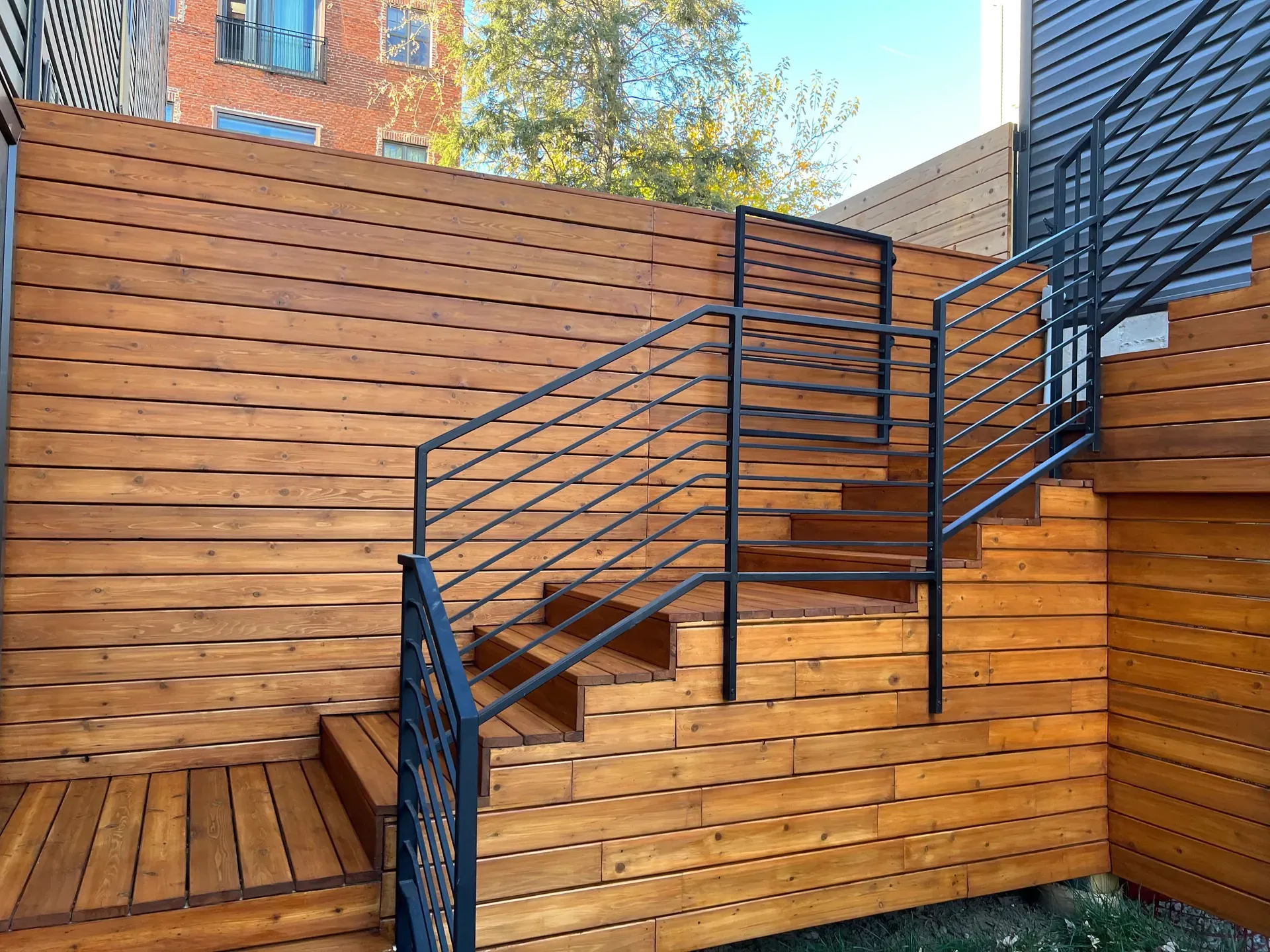
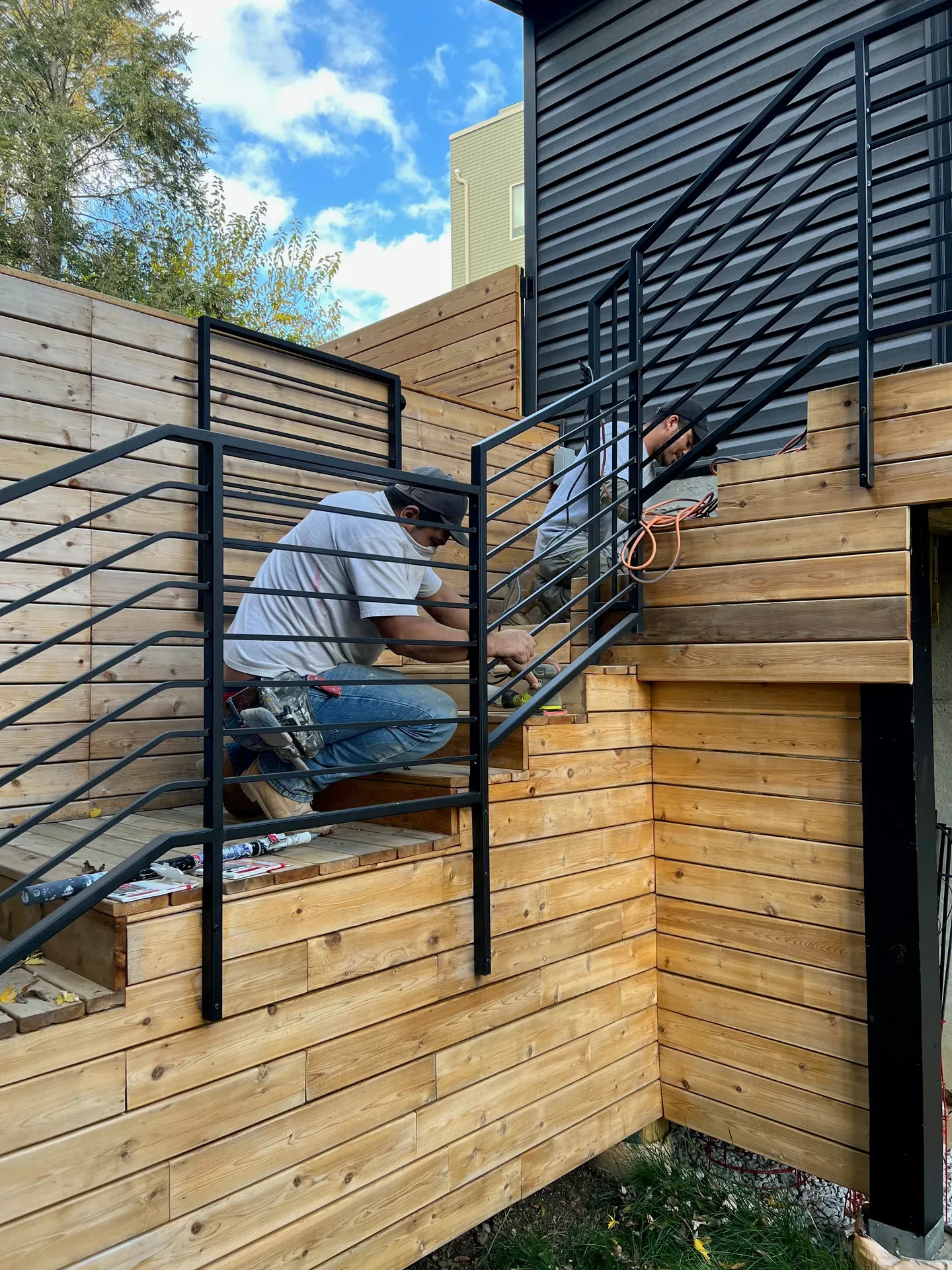
Exterior stair construction in the urban Philadelphia rowhouse market is a common JL specialty. The typical scope is a stair that connects two grade levels (street to first floor, first to second, or yard to deck level) and has to meet the local building code for rise/run uniformity, total run length, and railing height — typically 36-inch residential rail height in PA. JL fabricates and installs the structural framing (pressure-treated stringers, or steel angle stringers for higher load applications), the tread and riser assembly (cedar, ipe, or composite per the design), and the railing system. Railing options range from welded steel fabricated to spec to commercially-prepared powder-coated rail and post systems (Trex Signature, Fortress, or similar). The cedar surround that wraps the stair structure ties it visually to the building.
Finishing exterior wood is the deciding factor for how long the work looks new before maintenance is required. Western Red Cedar can be: left to weather to a uniform silver patina (zero maintenance after install, 12–24 months to fully patina, requires acceptance that the wood will not retain its original honey-amber tone), treated with a clear penetrating oil like Penofin Hardwood or Cabot Australian Timber Oil (preserves the original cedar color tone, requires recoat every 24–36 months on exposed walls), finished with a semi-transparent or semi-solid stain (more pigment loading, longer recoat interval of 4–6 years, slight obscuration of the wood grain), or finished with solid (opaque) stain in a specified color (longest recoat interval but the hardest to maintain when failure begins). JL specifies the finish based on the wall's exposure profile — south- and west-facing cedar in full sun degrades twice as fast as north-facing cedar — and the homeowner's maintenance commitment.
Service area covers Montgomery County and the broader Philadelphia metropolitan area, with significant project history in the urban rowhouse market where cedar T&G and steel-rail stair construction is particularly common. JL handles the work end-to-end as a single-trade scope: structural framing, carpentry, railing fabrication or install, and finish application. For larger projects involving demolition of existing stair structures, foundation modifications, or work that requires building permits, JL coordinates with the homeowner on the permit application process and works to the approved drawings. Every estimate walk includes a substrate condition assessment (any existing structure that will be modified or attached to), code clearance for the local jurisdiction if applicable, and a written scope before any material is ordered.