The work
How garage floor epoxy coating actually goes on a JL job.
The difference between a garage floor coating that holds up for a decade and one that delaminates inside the first year is concrete preparation. Acid etching — the standard method in big-box-store epoxy kits — produces a concrete surface profile of roughly CSP 1, which is marginally adequate on freshly-poured rough-finish slabs and inadequate on troweled, sealed, or older concrete that makes up the majority of Montgomery County garages. JL Drywall and Painting prepares every garage slab with mechanical diamond grinding to a CSP 3–4 profile, which creates a mechanical key the epoxy can bond into rather than relying solely on chemical adhesion. The grinder is followed by HEPA-filtered vacuum extraction — any residual dust left on the prepped slab will block the primer bond.
Moisture is the second hidden failure mode and the one most homeowners do not realize they have until a year after their first coating failed. Concrete slabs that feel dry to the touch can still have substantial moisture vapor transmission from the soil below the slab, especially in homes built before 1985 where a proper vapor barrier was either omitted or installed inadequately. Common Montgomery County housing patterns where this matters: 1960s–1970s East Norriton split-levels with poured-in-place direct-bearing slabs, 1980s King of Prussia townhomes with monolithic pour foundations, and any home with a garage on a graded fill slope where soil moisture migrates uphill toward the slab. JL performs a calcium chloride moisture test (ASTM F1869) or, on tighter timelines, an in-situ relative humidity probe (ASTM F2170) before specifying the coating system. If moisture vapor transmission exceeds the manufacturer's spec for the chosen epoxy, a moisture-mitigating primer goes down first — typically a 100% solids epoxy moisture barrier from a manufacturer like Koster or Sika.
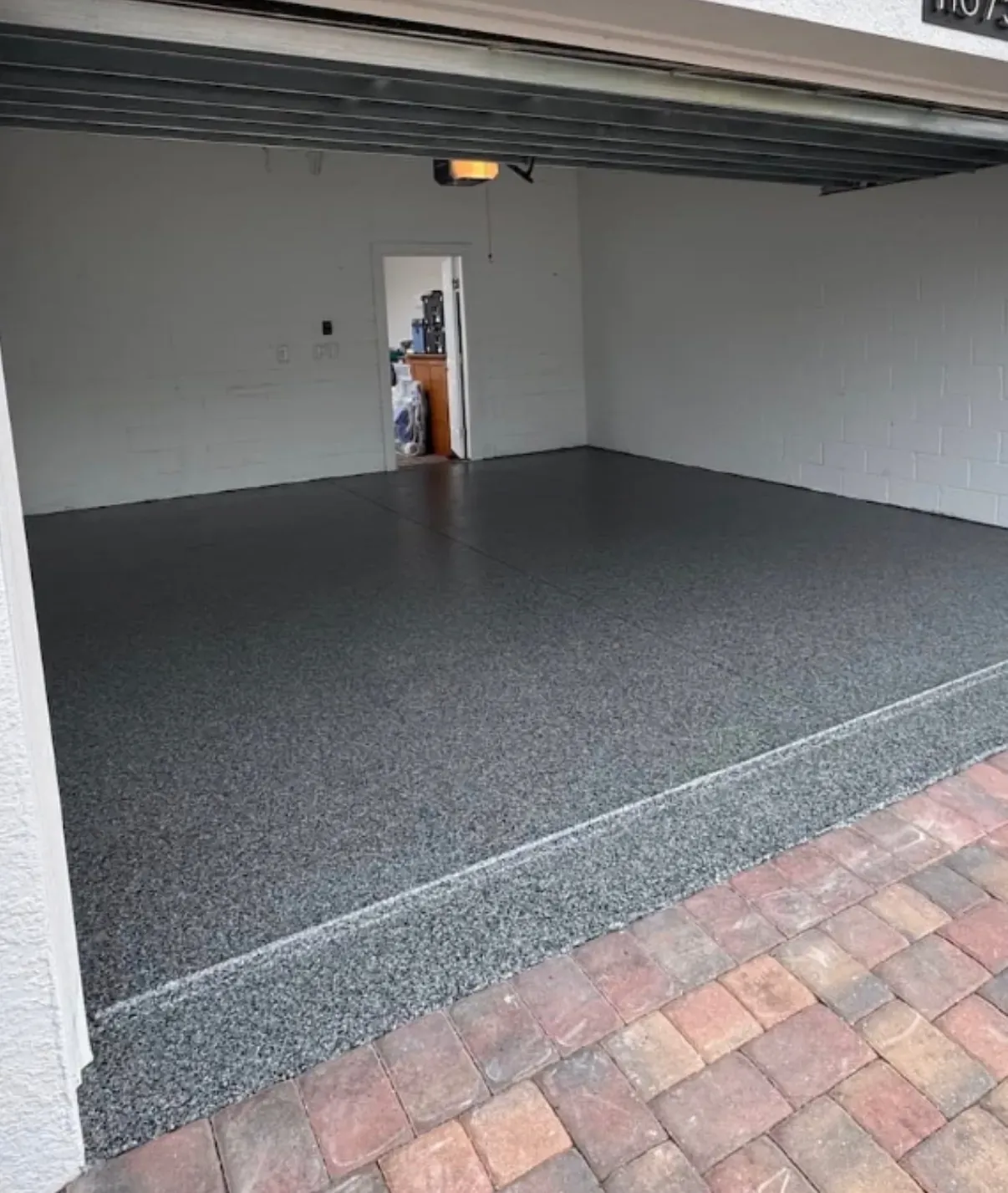
Coating system selection follows substrate prep and moisture results. The residential gold standard is a three-coat system: a 100% solids epoxy prime coat (Sherwin-Williams ArmorSeal 1K HS or Rust-Oleum Industrial Choice 9100), broadcast vinyl color-flake (Torginol or Decoflake, 1/4 to 1 lb per square foot depending on coverage), and a clear polyaspartic urethane topcoat (Polaris ProTec or equivalent). The polyaspartic topcoat is the most important component for UV stability and abrasion resistance — pure epoxy yellows under any UV exposure and is significantly softer than polyaspartic. For homeowners with budget constraints or aesthetic preferences, a single-coat polyaspartic system (no flake, no primer for some products) is available but costs more per square foot than the three-coat epoxy-and-topcoat system despite using less material.
Failure modes worth knowing: hot tire pickup happens when a cheap acrylic or single-part epoxy coating softens under tire heat and lifts when the tire cools — JL does not install single-part or acrylic coatings for this reason. Peeling at slab edges happens when the grinder does not chase the prep back into the edge sweep around the perimeter — JL's edge-grinding protocol uses a hand grinder to take the prep into corners and along the slab edge before the field is ground. Yellowing under UV happens when the topcoat is standard aliphatic epoxy rather than polyaspartic — JL specifies polyaspartic topcoat as standard. Efflorescence push-through happens when uncontrolled moisture vapor transmission pushes mineral salts up through the coating from the slab below — solved by moisture testing before specification and using a moisture-mitigating primer when readings warrant it.
Typical residential installation for a two-car garage at approximately 400 square feet is a two-day install with proper prep, or three days with full moisture mitigation. Day one: cover and protect any items the homeowner cannot remove, grind the slab to spec, vacuum, perform any joint or crack repair with a polyurea or epoxy crack filler, and perform moisture testing. Day two: prime coat down by 8 AM, color-flake broadcast into the wet primer, evening polyaspartic topcoat after the primer has set. Floor walkable the next morning, light vehicle traffic at 24 hours, full load (parking long-term) at 72 hours. The same system applies to basement floors, workshop floors, and any concrete slab in conditioned or semi-conditioned space where a hard wearing finish is required.