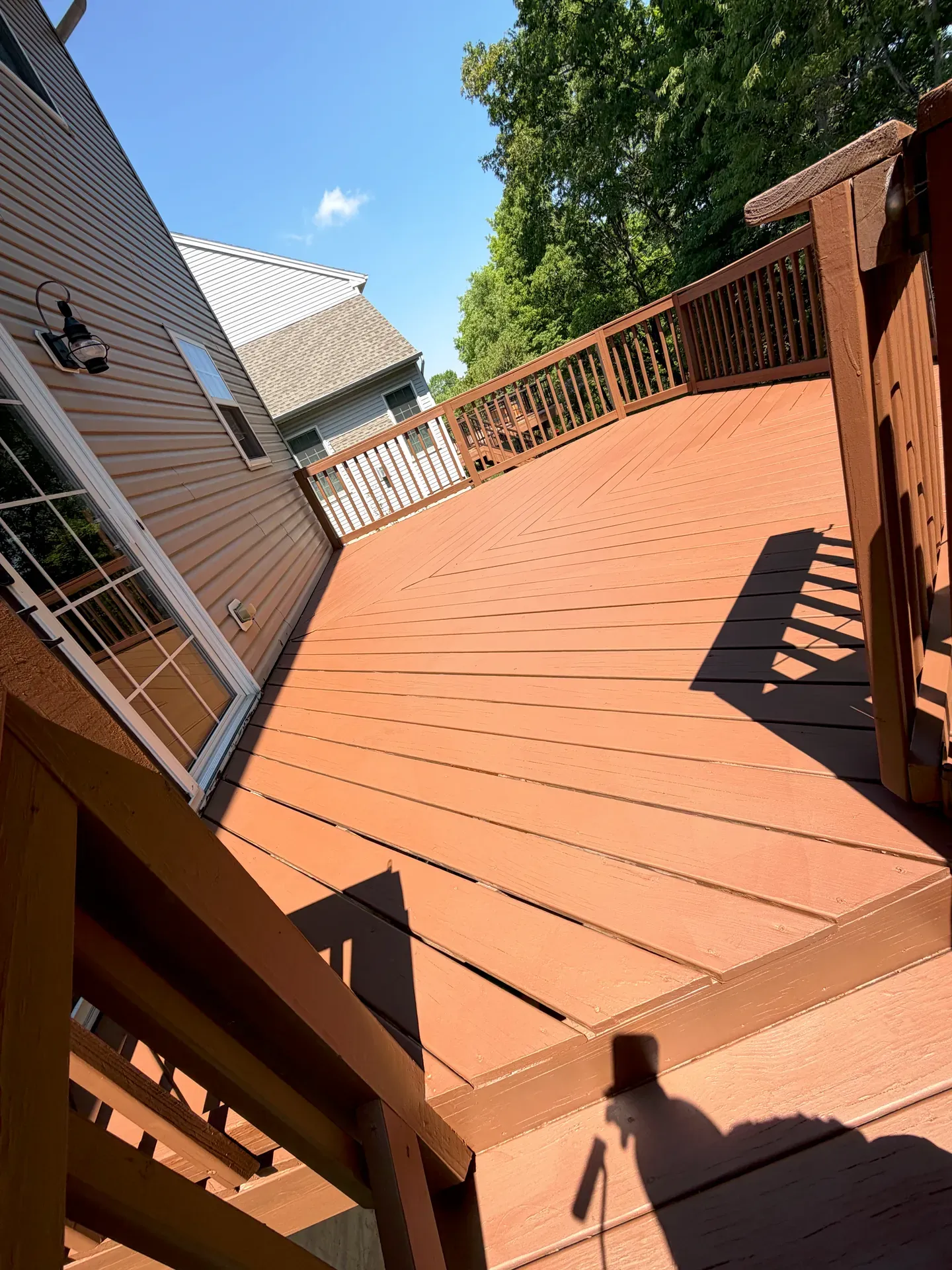
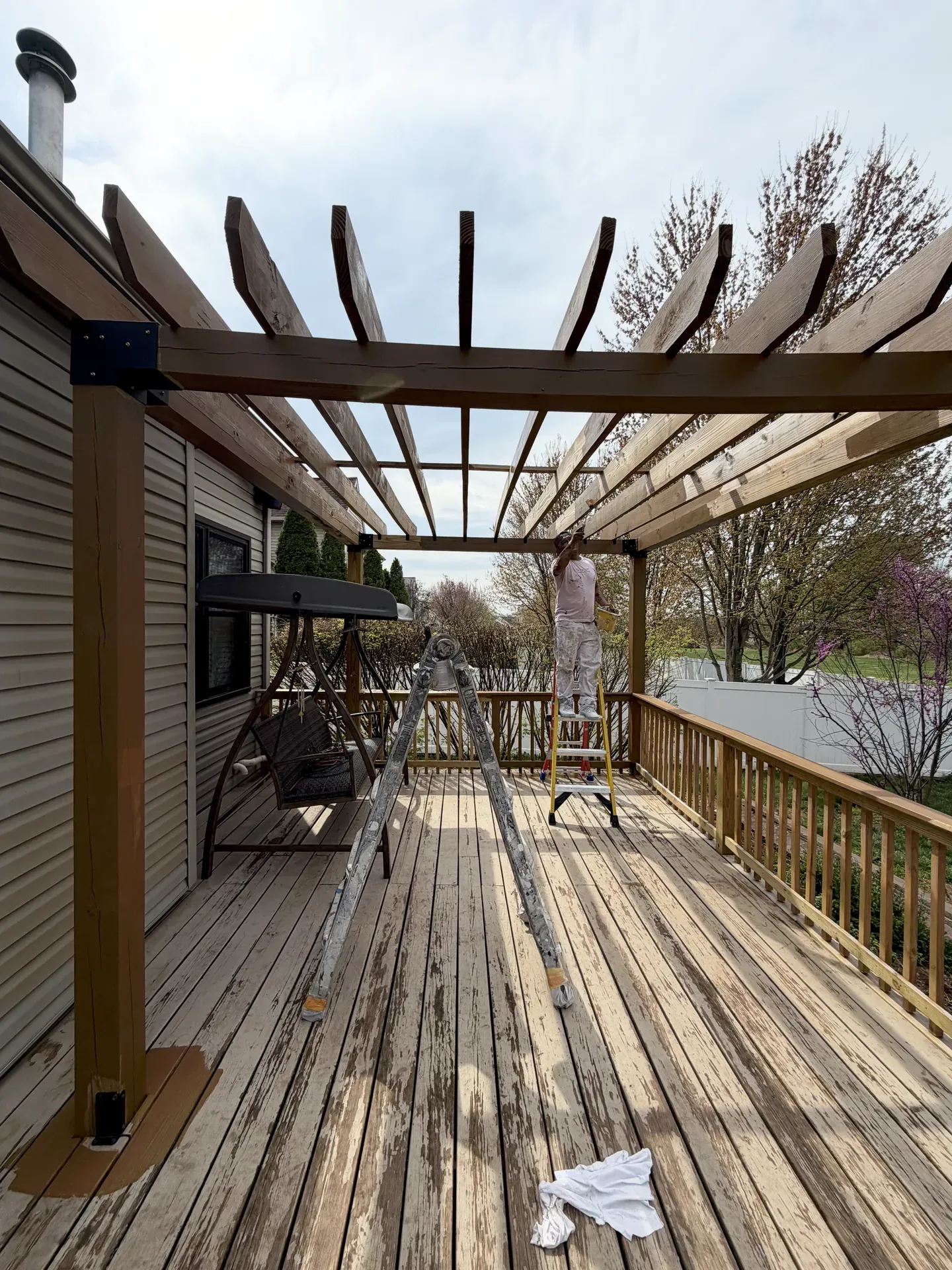
The work
How deck refinishing actually goes on a JL job.
Eastern Pennsylvania weather is exceptionally hard on wood decks. Summer UV degrades the lignin in the surface fibers, winter freeze-thaw cycles drive water in and out of every check and end-grain, and falling leaves leave tannin staining if they are not cleared before the first hard frost. The result is that most decks installed during the 1990s–2010s housing boom across Montgomery County are now on their third or fourth refinish — and a meaningful percentage of those refinishes have failed within two to three years, typically with peeling at the field, cracking at the railings, or a uniform gray weathered look returning under what was supposed to be a five-year stain.
The reason most deck refinishes fail is not the product. It is the surface preparation. A pressure-washed but unsanded deck has compressed, slick fibers at the surface that no stain can penetrate; a sanded but un-neutralized deck has elevated pH from prior cleaner that prevents oil-based finishes from drying correctly; a stripped solid-color deck still has residual coating in the grain that prevents transparent finishes from absorbing evenly. JL Drywall and Painting approaches deck refinishing as a substrate diagnosis first, then a finish selection — not the other way around. Jose walks the deck during the estimate, identifies the original wood species and prior finish history, and writes a scope that addresses the substrate condition before any product is specified.
Substrate identification drives the protocol. Pressure-treated southern yellow pine (the most common Montco deck material since the late 1980s) accepts oil-based and water-based penetrating finishes well after proper prep, but is prone to checking on the surface that requires careful end-grain treatment. Cedar (found on older premium decks and many 1970s–1980s second-story additions in Blue Bell and Skippack) is softer, more absorbent, and develops a silver patina that some homeowners prefer to preserve rather than restore. Brazilian hardwoods like ipe or cumaru (premium new builds) have such high natural oil content that standard deck stains will not adhere — these require specialty UV oils like Penofin Hardwood or Messmer's UV Plus. Composite decking (Trex, TimberTech) does not refinish in the conventional sense, but oxidized composites can be brightened and recoated with composite-specific products.
The cleaning and prep sequence is multi-day. Day one: sodium percarbonate cleaner brushed in, dwell time, low-pressure rinse (high-pressure wash damages the surface fibers — this is a common source of failed refinishes). Day two after the deck is fully dry: 60-grit sanding on the field, 80–100 grit on railings and horizontal trim, hand-sand on tight returns and end-grain. Day three weather permitting: brush-applied or sprayed finish, with end-grain sealed first and railing-to-post connections back-brushed. For solid-color failures where the prior opaque stain is peeling, the protocol shifts to a full strip with sodium hydroxide or methylene-chloride-free chemical stripper, neutralize, sand, then re-finish — there is no shortcut that produces a lasting result.
JL Drywall and Painting handles deck refinishing across North Wales, East Norriton, King of Prussia, Blue Bell, and Skippack — every Montgomery County exposure profile from south-facing full-sun rear decks to shaded north-facing porches under mature canopy. Finish products are specified per exposure: south- and west-facing decks get higher-pigment finishes that block UV more aggressively; shaded decks can use more transparent finishes that show the wood grain. Jose does not apply a finish coat unless the forecast shows 48 hours of dry weather above 50°F, and never in direct sun on a hot surface — both conditions guarantee finish failure regardless of product.